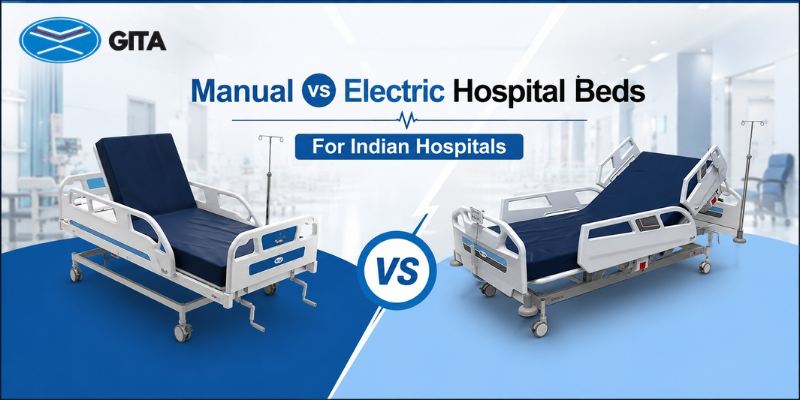
If you are setting up a new ward or replacing old furniture in your facility, you have probably faced this exact question. Should you go with a simple manual bed or spend more on an electric one? Every hospital furniture manufacturer will give you a slightly different answer depending on what they stock, so it helps to understand the real difference before you decide.
The truth is that neither option is universally better for Indian hospitals. A general ward and an ICU have completely different needs, budgets vary widely across cities and hospital sizes, and matching the bed type to the department saves both money and future headaches. This guide breaks down what each bed type offers so you can make the right call for your hospital.
What a Manual Hospital Bed Actually Offers
A manual hospital bed uses hand cranks to adjust the head and knee sections instead of a motor. Nursing staff turn a lever at the foot of the bed to raise or lower each section, and there is no electricity involved at any point. This keeps the bed simple, affordable, and easy to maintain over years of daily use.
A plain hospital bed like this works well in departments where patients do not need constant repositioning. General wards, recovery rooms, and step-down units are good examples. The lack of electronics also means fewer breakdowns and no dependence on power backup during outages.
Where Plain Hospital Beds Work Best
Plain hospital beds suit stable patients who can move around with minimal assistance. They also work well in smaller hospitals and nursing homes where budgets are tight and bed turnover is high. Since there are no motors or batteries to service, maintenance costs stay low for years.
Limitations Nursing Staff Should Know
The biggest drawback is speed. During an emergency, cranking a bed manually takes longer than pressing a remote button, and that time matters in critical situations. Manual beds also need more physical effort from staff, which adds up across a busy shift.
What Makes an Electric ICU Bed Different
An electric ICU bed runs on a motor that adjusts the head, knee, and height sections at the push of a button. Nurses can reposition a patient instantly without disturbing IV lines, catheters, or ventilator tubing. This single feature is why electric beds dominate critical care settings across India.
Most electric ICU beds also include Trendelenburg and reverse Trendelenburg positions, which tilt the entire bed instead of just one section. These positions are used during specific emergencies and are simply not possible on a manual bed. If you want to understand what compliance bodies expect from ICU furniture, our post on ICU bed standards in India covers NABH, ISCCM, and ISO requirements in detail.
Semi-Electric vs Fully Electric
A semi-electric hospital bed in India typically motorises the head and knee sections while keeping height adjustment manual. This is a popular middle ground for semi-private rooms and maternity wards where full ICU features are not required but some motorised comfort is welcome. Fully electric beds motorise every section and usually cost more.
Why ICUs Can’t Compromise
In intensive care, seconds matter, and a manual crank simply cannot keep pace with a code blue situation. Fully electric beds with quick response controls are considered a baseline requirement in most NABH accredited ICUs today. This is not a place to save money by downgrading the bed type.
Cost Comparison: Manual vs Electric Beds
Manual beds cost significantly less upfront and have almost no ongoing maintenance beyond basic mechanical checks. Electric beds cost more initially and need occasional servicing of the motor and control panel. Over a ten-year period, the gap narrows somewhat once you factor in electric beds reducing nursing time and injury risk from manual handling.
For hospitals working with tight capital budgets, a mixed approach often makes the most sense. Keep manual or semi-electric beds in general wards and reserve fully electric beds for ICU and high dependency units. This way your total spend stays realistic without compromising where it actually matters.
Choosing Ward Care Furniture Based on Department Needs
Not every department needs the same bed, and treating ward care furniture as a single category is where many hospitals go wrong. General wards can run comfortably on manual or semi-electric beds paired with bedside lockers and tables. Post-operative and maternity wards benefit from semi-electric options since patients need some positioning help but not full ICU features.
Critical care, however, should never be furnished on a budget. Trauma centres, cardiac units, and neuro ICUs all need fully electric beds with proper weight capacity, antimicrobial surfaces, and rail designs suited to that specific patient population. Matching bed type to department this way keeps both your budget and your patient outcomes in a healthy place.
How to Pick the Right Hospital Bed Manufacturer
Once you know which bed type each department needs, the next step is finding a reliable hospital bed manufacturer who can supply both categories without compromising on either. Ask for product samples before placing a bulk order, since a bed that looks solid in a catalogue can feel flimsy once you actually sit on it. A physical demo of the electric controls is worth the extra time before you commit.
Check whether the manufacturer offers a structural warranty and an Annual Maintenance Contract, especially for electric beds where the motor and control panel need occasional servicing. A dependable manual hospital bed manufacturer should also be transparent about weight capacity ratings, since general wards and bariatric units have very different requirements.
Wrapping Up
Manual and electric hospital beds both have a place in a well-run hospital, and the right choice depends entirely on which department you are furnishing. General wards do fine with manual or semi-electric beds, while ICUs and critical care units need the speed and precision that only electric beds can offer.
If you are ready to compare options, Gita Mediquip supplies both dependable manual beds and advanced electric ICU beds built for Indian hospital conditions. Check out our Artha manual hospital bed for general wards or the Shree electric ICU bed for critical care, and get in touch with our team for a customised quote from a trusted hospital bed manufacturer today.