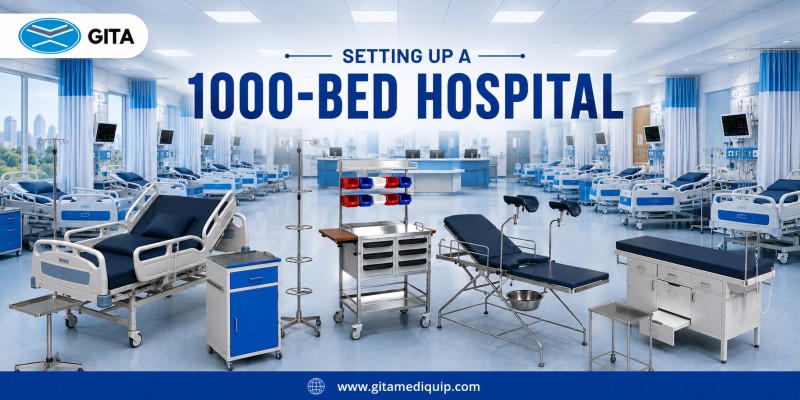
Heading procurement for a hospital of this scale means handling a different kind of project altogether. A 1000-bed facility isn’t a scaled-up version of a 200-bed hospital; the decisions multiply, the vendor conversations multiply, and so do the delivery timelines you’re used to managing. Getting hospital furniture for corporate hospitals right at this scale takes a level of planning that a mid-size facility never demands.
Once you break the project down department by department instead of treating it as a single purchase order, it becomes manageable. This guide walks through how to build that checklist for a 1000-bed facility in India.
Start With Your Bed Count and Department Split
A hospital this size is really a cluster of departments, and each one needs its own bed type and furniture mix. Before ordering a single bed, sit down with your clinical team and map out how the 1000 beds split across general wards, ICU, maternity, paediatrics, and private rooms. This bed count matrix should anchor your entire procurement plan.
Getting your hospital bed for new hospital setup order right depends on this split. A hospital that under-plans ICU capacity, or over-orders private room furniture, ends up scrambling to fix gaps after opening, and that costs far more than getting it right the first time.
Why Department-Wise Planning Matters
Each department turns over patients at a different pace and carries its own infection control needs and bed specifications. Treating furniture as one bulk order instead of planning it department by department is one of the most common mistakes hospital administrators make at this scale.
General Wards Need Fowler Beds, Not Basic Ones
At 1000 beds, general wards alone could account for 400 to 450 beds, making this your single largest furniture category. A plain manual bed without head elevation doesn’t suit most general ward patients, particularly those recovering from surgery or managing respiratory conditions.
A Fowler bed for hospital wards lets nursing staff raise a patient’s head and knees without physical strain, which matters even more at high patient volumes where staff are already stretched thin. ABS panel construction is worth the extra cost here, since it holds up better against frequent disinfection than painted steel.
Private and Semi-Private Rooms Need a Different Finish
Private and semi-private rooms usually make up 15 to 18 percent of total beds in a corporate hospital, and patients here expect a more hotel-like finish without losing clinical function. Fowler beds with ABS side panels, paired with matching bedside lockers and cantilever tables, give these rooms a cleaner look while staying fully functional for nursing care.
ICU and Critical Care Cannot Be an Afterthought
A hospital of this size typically needs somewhere between 80 and 100 ICU beds spread across general, cardiac, neuro, and surgical critical care units. Cutting corners here does the most damage, both to patient safety and to your NABH accreditation chances.
An ICU bed for multispecialty hospital use needs full electric positioning, Trendelenburg function, and sturdy side rails that hold up under constant monitoring equipment. Manual ICU beds can work for a step-down HDU, but ventilated patients in cardiac or neuro ICU need beds that reposition instantly without disturbing tubing or lines. Our earlier guide on manual versus electric hospital beds covers this decision in more depth.
Don’t Forget Isolation and HDU Beds
Isolation wards and high dependency units usually need 2 to 3 percent of total bed capacity, but they get overlooked in early planning because they sit between general wards and full ICU. These beds still need ICU-grade features, like side rails and easy-clean surfaces, even though the unit itself isn’t classified as intensive care.
OT Complex and Equipment Planning
A 1000-bed hospital typically runs 15 to 20 operation theatres, and each one needs its own tables, trolleys, and stools before it can function. Planning your ot equipment early matters because electric OT tables alone can take 8 to 12 weeks to manufacture and deliver.
Beyond the table itself, every OT needs mayo trolleys, anaesthesia trolleys, kick bucket stands, and scrub area furniture. Recovery bays attached to each OT also need their own beds or trolleys, a line item hospitals frequently underestimate.
Pre-operative holding bays deserve the same attention. Patients waiting to go in for surgery need proper trolleys with side rails and IV stand attachments, not repurposed ward beds. Transfer safety and infection control both depend on using equipment built for that specific step in the surgical workflow.
Choosing the Right Vendor for a Project This Size
At 1000-bed scale, you’re not placing one order. You’re managing a supply relationship that has to hold up across months of phased delivery. This is where researching top hospital bed manufacturers in India actually pays off, instead of picking the first vendor with the lowest quote.
Look for manufacturers with ISO 13485 and CE certification, a track record with hospitals of comparable size, and a service network that can reach your city. A vendor without after-sales support becomes a serious problem the moment a bed’s motor or crank mechanism needs repair two years into operation.
Wrapping Up
Furnishing a 1000-bed hospital takes months, not a single purchase order, and the hospitals that get it right start planning furniture at the same time they plan equipment and construction. Break the process down by department, prioritise ICU and OT specifications early, and give your vendor enough lead time to deliver in phases without rushing quality.
If you’re working on a large hospital setup and want help building a department-wise furniture plan, Gita has been supplying hospitals across India since 1987 as a trusted hospital bed manufacturer. Visit our website to explore the full range and get in touch with our team for a project-specific quote.