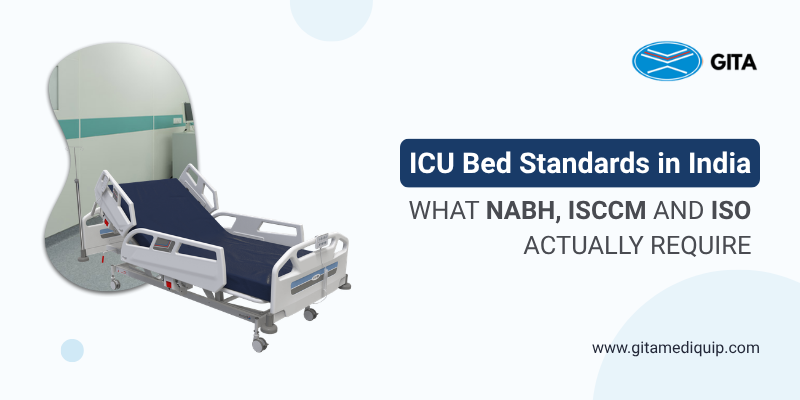
Most hospital procurement conversations about ICU beds start with one question: what is the price? That is the wrong question to lead with. The right starting point is: what does this ICU bed need to do, and does it comply with the standards that will govern this facility’s accreditation and clinical outcomes?
ICU bed standards in India are shaped by three distinct regulatory frameworks NABH, ISCCM, and ISO. Each addresses a different dimension of the same problem. NABH sets the infrastructure and operational minimums that hospitals must meet to achieve accreditation. ISCCM defines the clinical best practices that drive patient outcomes in critical care. ISO validates the quality management systems of the manufacturer producing the hospital bed. Understanding all three is what separates a well-informed procurement decision from a price-driven one.
With NABH accreditation now serving as a prerequisite for empanelment under AB-PMJAY and most major insurance schemes, hospitals can no longer treat ICU bed procurement as a cost-led exercise. The consequences of getting it wrong non-compliance, failed inspections, poor clinical outcomes are too significant.
The Three Regulatory Frameworks Governing ICU Bed Standards in India
Before getting into the specifics of what each body requires, it helps to understand what each framework covers and why all three matter.
| Framework | Governing Body | What It Covers | Why It Matters |
| NABH | National Accreditation Board for Hospitals & Healthcare Providers | Hospital infrastructure, staffing, infection control, operational processes | Required for insurance empanelment, AB-PMJAY, and patient trust |
| ISCCM | Indian Society of Critical Care Medicine | Clinical design guidelines, bed specifications, staffing ratios, ICU unit sizing | Defines clinical best practice; adopted by NABH for ICU design standards |
| ISO 13485 | International Organization for Standardization | Quality management systems for medical device manufacturers | Validates manufacturer quality; required for institutional procurement documentation |
These are complementary, not competing frameworks. A hospital that understands all three is equipped to write procurement specifications that reflect both regulatory compliance and clinical need and to evaluate vendors against standards that actually matter.
NABH ICU Bed Standards in India: What the 6th Edition Actually Requires
NABH accreditation is administered by the National Accreditation Board for Hospitals and Healthcare Providers, a constituent board of the Quality Council of India. The current applicable framework is the NABH 6th Edition, released in September 2024.
NABH ICU bed standards in India are embedded within the broader infrastructure and care quality requirements of the accreditation programme. The ICU-specific requirements include:
| Requirement Area | NABH Standard |
| Floor area per ICU bed | 150-200 sq ft in the patient care area |
| Nurse-to-patient ratio | 1:1 in all shifts for all ICU patients |
| Entry restriction | Demarcated restricted zone; hand hygiene at ICU entry mandatory for all staff |
| Staff certification | ICU nurses trained in intensive nursing care; BLS certification required |
| Bed-side equipment | Monitoring systems, ventilators, IV pumps bed must accommodate all without obstruction |
| Infection control surfaces | Antimicrobial or easily sterilisable surfaces preferred; clean and contaminated areas separated |
| Side rails | Full-length collapsible side rails required for patient fall prevention |
| Height adjustment | Hi-lo adjustment required for safe patient transfer and nursing ergonomics |
NABH ICU bed standards in India also track specific quality indicators for ICU performance. These include hospital-acquired infection rates, standardised mortality rates, accidental tube removal rates, average length of ICU stay, and compliance with ICU admission-discharge criteria. Each of these outcomes is directly influenced by the design and functionality of the ICU bed, particularly the quality of rails, height adjustment mechanisms, and surface materials.
NABH ICU bed standards in India are assessed during both pre-certification and full accreditation inspections. Non-compliant infrastructure including beds that do not meet the specified requirements can result in demerits or outright deferral of accreditation. For a facility seeking insurance empanelment, this has direct financial consequences.
ISCCM Guidelines: What India’s Critical Care Body Actually Recommends
The Indian Society of Critical Care Medicine is the professional body for intensivists in India. Its guidelines on ICU planning and designing were first published in 2001, updated in 2007, and most recently revised through a comprehensive consensus process in 2020. These guidelines have been adopted by NABH and represent the clinical benchmark for ICU design across India.
The ISCCM 2020 Consensus Statement on ICU Planning and Designing covers unit sizing, space requirements, staffing ratios, infrastructure standards, and equipment provisioning. Key recommendations relevant to ICU bed in hospital procurement:
- Ideal ICU size: 8 to 14 beds per unit. Units below 6 beds are clinically unviable and insufficient for staff training. Units above 14 beds increase staff stress and may negatively affect patient outcomes.
- Patient care area: A minimum of 150 sq ft per bed; 200 to 250 sq ft is recommended for high-acuity cases. Bays handling ECMO, renal replacement therapy, or other complex interventions require additional space.
- Isolation rooms: At least 10 percent of ICU beds (1 to 2 rooms) should be isolation-capable, with 20 percent additional space and appropriate pressure ventilation.
- HDU positioning: The High Dependency Unit should be adjacent to or within the ICU complex, sized at up to 50 percent of the main ICU bed count. Nurse-to-patient ratio in HDU may be relaxed to 1:2 or 1:3.
- Staffing: Ideal doctor-to-patient ratio is 1:5. Ventilated patients require a 1:1 nurse ratio; non-ventilated patients may be managed at 1:2.
- Power backup: ICU must have dedicated, auto-starting power backup sufficient to maintain temperature and run all ICU equipment.
The ICU bed in hospital settings, as per ISCCM guidance, must support full Trendelenburg, reverse Trendelenburg, and hi-lo adjustments. It must accommodate monitoring equipment and allow unobstructed staff access from all four sides. These are not optional features they are clinical requirements for safe patient management in any ICU bed in hospital at Level II or Level III classification.
The ISCCM classifies ICUs into three levels. Level I is a basic monitoring unit without ventilation capability. Level II provides non-invasive and invasive ventilation with organ support for most conditions. Level III is the highest classification, providing full critical care including extracorporeal therapies, and must operate as a closed ICU under specialist intensivists. The bed specification must match the level of care a Level III ICU running on manual ward beds is a clinical governance failure.
Mandatory Features on a Compliant ICU Bed in India
Translating the NABH and ISCCM requirements into a practical procurement specification means identifying which bed features are genuinely mandatory versus optional. The table below maps the key features to the standards that require them.
| Bed Feature | Clinical Purpose | Standard Reference |
| Height adjustment (Hi-Lo) | Safe patient transfer; reduces nursing strain and fall risk | NABH / ISCCM |
| Side rails (collapsible, full-length) | Patient fall prevention; NABH compliance requirement | NABH |
| Trendelenburg / Reverse Trendelenburg | Hemodynamic management and airway positioning in critical patients | ISCCM |
| Fowler / Back-rest adjustment | Post-operative positioning; ventilator-associated pneumonia prevention | ISCCM / Clinical practice |
| Lockable castors (4 x 125mm minimum) | Bed stability during procedures; safe patient transport | NABH / Safety standard |
| ABS or CRCA steel frame | Infection control; smooth non-porous surfaces; corrosion resistance | NABH infection control norms |
| IV rod provision | Workflow efficiency; required in ICU bedside setup | NABH |
| Equipment shelf/platform space | Accommodates monitoring equipment at bedside without obstruction | ISCCM design standard |
| Weight capacity (250 kg minimum) | Bariatric patient management; structural safety | ISO / Manufacturer standard |
| CPR flat / immediate release | Emergency cardiac response mandatory in any ICU environment | ISCCM |
An ICU bed with ABS rails deserves specific mention here. ABS (acrylonitrile butadiene styrene) side rails and head/foot panels are the material standard under NABH infection control requirements because ABS surfaces are smooth, non-porous, resistant to repeated chemical disinfection, and do not corrode in humid environments. Beds with painted steel rails or lower-grade plastic components degrade faster and present infection control risks that become visible within the first two to three years of operation.
Manual vs. Electric ICU Beds: Which Is Right for Your Unit?
This is one of the most frequently asked questions in ICU procurement, and one that is too often answered on the basis of budget alone. The right answer is clinical; it depends on the level of care the unit is designed to provide and the acuity of the patient population.
| Manual ICU Bed | Electric ICU Bed |
| Suitable for Level I and Level II ICUs | Required for Level III ICUs (cardiac, neuro, surgical) |
| Appropriate for HDU / step-down units where electric is not clinically required | Recommended for Level II ICUs in high-acuity private hospitals |
| Viable where reliable UPS power for motorised systems cannot be assured | Requires reliable UPS and power infrastructure |
| 40-50% of the cost of an equivalent electric ICU bed | 2-3x the cost of a comparable manual ward bed |
| Simpler staff training requirements | Faster repositioning in emergencies (CPR flat, anti-Trendelenburg) |
| No motor maintenance requirements | Reduces nursing physical effort and staff injury rates |
For a 500-bed multi-specialty hospital, the practical approach is a split specification: electric ICU beds for the cardiac, neuro, and surgical ICUs; well-specified manual ICU beds for general ICU and HDU units. This approach optimises clinical outcomes where they matter most while keeping procurement costs manageable across the full bed count.
A five function ICU bed manufacturer typically produces beds with motorised control of five primary positions: back-rest elevation, knee break, hi-lo height, Trendelenburg, and reverse Trendelenburg. This is the minimum function specification for an electric ICU bed intended for Level II or Level III ICU use. Beds marketed as ICU-grade but offering fewer than five motorised functions should be evaluated carefully against the unit’s clinical requirements before purchase.
Why ISO 13485 and CE Certification Matter in ICU Bed Procurement
For hospital procurement teams evaluating ICU beds for an NABH-accredited facility, the manufacturer’s certification documentation is not a formality, it is a procurement prerequisite.
| Certification | What It Means | Why It Matters for Procurement |
| ISO 13485:2016 | International QMS standard for medical device manufacturers. Covers design, production, risk management, and product traceability. | Required for institutional procurement documentation in NABH-accredited hospitals, government tenders, and AB-PMJAY empanelled facilities. |
| CE Marking | Confirms the device meets EU health and safety standards. Recognised in India as an international quality marker. | Provides safety and performance validation. Relevant for JCI-standard facilities and export-quality procurement. |
| ISO 9001:2015 | General Quality Management System standard covering process consistency and continuous improvement. | Baseline quality standard expected from any reputable manufacturer. Less device-specific than ISO 13485. |
| ISO 14001 / ISO 45000 | Environmental management and occupational health and safety standards. | Signals responsible manufacturing practice; relevant for facilities with ESG or sustainability procurement criteria. |
ISO 13485 certification is the most procurement-relevant of these certifications for ICU beds. It requires manufacturers to demonstrate consistent design processes, controlled production environments, risk management procedures, and full product traceability meaning that if a quality issue arises with a batch of beds, the manufacturer can identify and address it systematically. Hospitals that request this documentation and cannot receive it quickly are working with a manufacturer whose quality systems do not meet institutional procurement standards.
How Gita’s ICU Beds Meet These Standards
Gita manufactures two purpose-built ICU beds designed against these regulatory standards: the Prana (manual ICU bed) and the Shree (electric ICU bed).
The Prana ICU bed is designed for high-acuity patient care in general ICU, step-down, and HDU applications. It offers full Fowler, Trendelenburg, and reverse Trendelenburg positioning, with ABS head and foot bows on a CRCA steel frame. The frame and surface specification meets NABH infection control requirements.
The Shree is the flagship electric ICU bed in the range, designed for tertiary care environments and NABH-compliant Level II and Level III ICUs. Motorised controls cover hi-lo height adjustment, back-rest, knee break, Trendelenburg, and CPR flat position. Full-length collapsible safety rails are standard. The bed is built for the clinical demands of cardiac, neuro, and surgical ICUs where rapid repositioning, staff ergonomics, and patient safety infrastructure are non-negotiable.
Certifications applicable to the ICU bed range: ISO 9001, ISO 13485, ISO 14001:2004, ISO 45000, and CE Marking. Full certification documentation and product specification sheets are available on request.
Red Flags When Evaluating ICU Bed Vendors
A structured vendor evaluation process protects procurement teams from the most common and costly mistakes. The following checklist identifies the red flags that should trigger further scrutiny or disqualification:
- No ISO 13485 or CE certificate available on request. Certified manufacturers can provide documentation immediately. Delay or evasiveness on this point is a serious warning sign.
- Vague warranty terms. ICU beds should carry a minimum 2-year comprehensive warranty on frame and rails. Electric motors should carry a separate motor warranty of at least 1 year.
- No batch reports or inspection photos available. For large-quantity orders, procurement teams should be able to review production documentation and conduct pre-delivery inspections.
- No after-sales service infrastructure in your region. An ICU bed malfunction at 2 AM is a patient safety event. Verify the vendor’s service response capability and geographic coverage before signing any contract.
- Missing features: any ICU bed without full-length side rails, height adjustment, and Trendelenburg positioning cannot meet NABH ICU bed standards in India and ISCCM requirements. Do not accept compromises on these.
- Pricing significantly below market without clear material and specification disclosure. Unusually low prices frequently signal compromised material grade non-powder-coated steel, thin-gauge tubing, or substandard ABS that corrodes or degrades within 2 to 3 years.
- No verifiable references from comparable hospital projects. Ask for at least 2 to 3 project references from hospitals of similar scale and ICU acuity.
Conclusion
ICU bed standards in India are defined by three complementary frameworks: NABH sets the infrastructure and operational minimums, ISCCM defines the clinical requirements, and ISO validates the manufacturer’s quality systems. Understanding all three is what makes procurement decisions defensible both at the NABH accreditation inspection and at the bedside.
The choice between manual and electric ICU beds should be driven by the unit’s ISCCM level classification, not by budget alone. A Level III ICU handling ventilated cardiac or neuro patients needs electric beds. An HDU may function well with properly specified manual ICU beds. A mixed approach across a 500-bed multi-specialty hospital is usually both clinically sound and financially practical.
Not sure which ICU bed configuration is right for your unit’s classification? Our team can share product spec sheets and compliance documentation for both the Prana and Shree ICU bed range. The right bed for your ICU starts with the right conversation about what your unit needs to do.