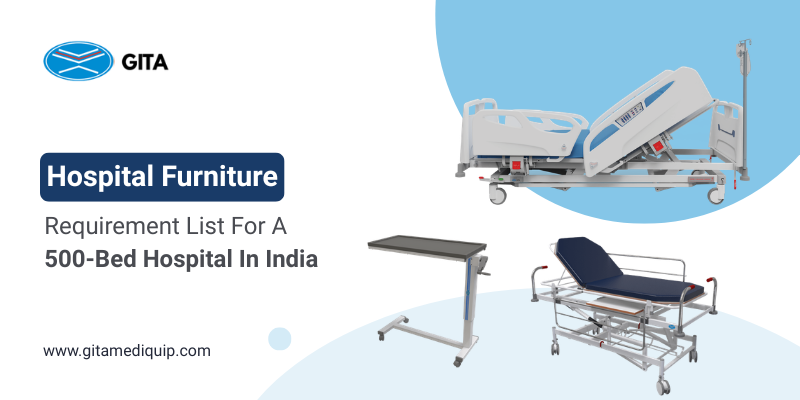
When hospital administrators and project consultants sit down to plan a new facility, infrastructure budgets and medical equipment procurement typically dominate the conversation. Hospital furniture, the beds, trolleys, lockers, and OT accessories that every department needs from Day 1 often get pushed to the final few weeks before commissioning. This is one of the most preventable and costly mistakes in hospital project management.
For a 500-bed multi-specialty hospital, the hospital furniture requirement is not a single purchase order. It is a structured, department-wise procurement exercise involving hundreds of line items across dozens of categories. Getting the hospital furniture requirement right, on time and to specification, directly determines whether your facility opens on schedule, clears NABH pre-certification checks, and functions efficiently from the very first day.
This guide lays out the complete hospital furniture requirement for a 500-bed hospital in India, department by department, along with practical guidance on quantity estimation, planning timelines, and procurement best practices.
Why the Hospital Furniture Requirement Is the Most Under-Estimated Step in Hospital Setup
Hospital construction in India typically spans 24 to 48 months. Equipment procurement for diagnostics, imaging, and surgical systems usually starts 12 to 18 months before the planned opening date. Hospital furniture, however, is frequently treated as a last-minute afterthought ordered 60 to 90 days before opening.
The consequences are predictable: compressed timelines mean limited vendor evaluation, rushed BOQ preparation, incorrect specifications, and phased delivery schedules that miss commissioning deadlines. For a 500-bed hospital, this translates into delayed ward activation, NABH inspection deferrals, and nursing workflow disruptions that affect patient care quality from the very first admission.
The hospital furniture requirement for a project of this scale must be planned 6 to 9 months before the intended opening date. That planning window allows the procurement team to build an accurate BOQ, evaluate and shortlist vendors, negotiate supply and delivery contracts, coordinate phased delivery aligned with construction floor completion, and plan staff orientation on specific equipment, especially electric ICU beds and OT systems.
The India hospital furniture market was valued at USD 378 million in 2024 and is growing at over 10% annually, driven in large part by new private hospital capacity being added across Tier 1, 2, and 3 cities. For a new hospital setup, this means more vendors in the market but also more variability in quality and compliance, making systematic vendor evaluation essential.
Understanding the Scope: How a 500-Bed Hospital Breaks Down
A 500-bed multi-specialty hospital is not a uniform facility. It is a collection of clinical environments each with distinct patient populations, care workflows, and hospital furniture requirements. The starting point for any BOQ is a department-wise bed distribution.
The table below provides an indicative bed distribution for a 500-bed multi-specialty hospital in India. Actual allocations will vary based on the hospital’s clinical model, specialization mix, and applicable NABH or IPHS guidelines.
| Department | Approx. % of Total Beds | Approx. Bed Count | Primary Bed Type |
| General Ward (Medical/Surgical) | 40-45% | 200-225 | Fowler / Semi-Fowler Bed |
| ICU (General, Cardiac, Neuro, Surgical) | 8-10% | 40-50 | ICU Bed (Manual or Electric) |
| OT Complex (Pre-op/Recovery) | 4-5% | 20-25 | OT Trolley / Recovery Bed |
| Maternity and Labour | 8-10% | 40-50 | Delivery Bed / Labour Table |
| Paediatric / NICU | 6-8% | 30-40 | Paediatric Bed / NICU Warmer |
| Emergency / Casualty | 3-4% | 15-20 | Emergency / Stretcher Bed |
| Private / Semi-Private Rooms | 15-18% | 75-90 | Fowler Bed with ABS Panels |
| Isolation / HDU | 2-3% | 10-15 | ICU-grade / Fowler Bed |
These ratios are indicative. The exact allocation for your facility will depend on your specialty mix, clinical admission patterns, and any state government or central scheme norms applicable to your registration.
Department-Wise Hospital Furniture Requirement Breakdown
The following section covers the hospital furniture requirement for each major department in a 500-bed facility. This is the core of any BOQ and should be reviewed and refined in consultation with department heads and clinical leads before quantities are finalised.
A. General Ward (Medical and Surgical)
The general ward is the single largest zone in any hospital, typically housing 200 to 225 beds in a 500-bed facility. The hospital furniture requirement here is volume-driven and relatively standardised.
- Fowler Bed or Semi-Fowler Bed (manual, ABS panel construction preferred for infection control) – 1 per bed
- Bedside Locker – 1 per bed
- Overbed / Cantilever Table – 1 per bed in general wards (70% coverage minimum for mixed wards)
- IV Stand / Saline Stand – 1 per bed, with 10% buffer stock
- Attendant Chair or Sofa – 1 per patient bay (semi-private) or shared in open wards
- Nursing Station Counter with stools – 1 station per bay of 20-30 beds
- Instrument Trolleys, Dressing Trolleys – shared at a ratio of 1 per 8-10 beds
- Three-Fold Privacy Screen – 1 per 6-8 beds in open wards
For low-acuity medical wards, plain hospital beds are acceptable. Fowler beds are required wherever head elevation is a standard clinical need post-operative wards, respiratory wards, and any area managing patients at risk of aspiration.
B. ICU (Intensive Care Unit)
The hospital furniture requirement in the ICU is the most specification-sensitive and cost-intensive of all departments. ICU beds account for the largest per-unit cost in any hospital furniture procurement. A 500-bed hospital typically requires 40 to 50 ICU beds spread across general ICU, cardiac ICU, neuro ICU, and surgical ICU.
NABH norms require a minimum floor area of 150 to 200 sq ft per ICU bed in the patient care area, with additional space for nursing stations, storage, and circulation. ISCCM guidelines recommend 200 to 250 sq ft per bed for high-acuity cases. Every ICU bed must support full Trendelenburg and reverse Trendelenburg positioning, height adjustment, and accommodate monitoring equipment at the bedside.
- ICU Bed (manual or electric depending on unit classification) – 1 per bed position
- ICU Overbed / Cantilever Table – 1 per bed
- IV Stand (multi-hook, heavy duty) – 1 per bed plus 10% reserve
- Emergency Crash Cart / Resuscitation Trolley – 1 per 4-6 ICU beds
- Nurse Call system furniture provisions – integrated into bed unit layout
- Linen Trolleys and Utility Trolleys – shared per bay
- Central Nursing Station with ergonomic seating – 1 per ICU unit
- Medication Trolley – 1 per nursing station
Electric ICU beds typically cost 2 to 3 times more than manual ward beds. The decision between manual and electric should be driven by the clinical classification of the unit, not purely by budget. A cardiac or neuro ICU handling ventilated patients requires electric beds; a step-down HDU may function adequately with well-specified manual ICU beds. An ICU bed with ABS rails is a standard requirement under NABH infection control norms, as ABS surfaces are smooth, non-porous, and easier to disinfect than powder-coated steel.
C. OT Complex (Operating Theatre)
The OT complex hospital furniture requirement covers the operating theatres themselves, scrub areas, recovery rooms, and pre-operative holding bays. NABH norms specify a minimum floor area of 400 sq ft per operation theatre. Every item in the OT must meet the infection control, surface finish, and workflow requirements applicable to a sterile environment.
- OT Table (manual or electric) 1 per theatre. Electric OT tables cost 3 to 5 times more than manual versions.
- Mayo Trolley / Instrument Stand – 2 per OT
- Anesthesia Trolley – 1 per OT
- Kick Bucket Stand – 2 per OT
- OT Stool (surgeon and scrub nurse) – 3-4 per OT
- Scrub Sink / Wash Basin Stand – per scrub area layout
- Recovery Room Bed / Trolley – 2 per active OT
- Linen Trolley, Waste Trolley – 1 each per OT
- OT Step Stool (stainless steel) – 2 per OT
D. OPD and Consultation
The OPD is the highest-footfall zone in any hospital. NABH specifies a minimum consultation room size of 100 sq ft. The hospital furniture requirement here is relatively low-cost per unit, but the sheer volume of rooms a 500-bed hospital may have 20 to 40 OPD consultation rooms depending on its specialty mix makes this a significant line item.
- Examination Couch / Table – 1 per consultation room
- Doctor’s Table and Chair – 1 per room
- Patient Chair – 2 per room
- Dressing Trolley – 1 per 3-4 rooms
- Three-Fold Privacy Screen – 1 per room
- Height-Adjustable Stools – 1 per examination area
- OPD Waiting Area Chairs – calculated at 3-4 chairs per active consultation room
E. Emergency and Casualty
The Emergency department has some of the most demanding hospital furniture requirements in any hospital. Equipment must be mobile, durable, and designed for rapid patient assessment and intervention. The department works around the clock with high patient turnover and frequent equipment movement.
- Emergency Stretcher Bed / Trolley with collapsible side railings 1 per bay
- Resuscitation / Crash Cart 1 per 6-8 emergency bays
- Oxygen Cylinder Trolley 1 per 4 bays
- Portable Saline Stand 1 per bay
- Examination Table 1 per assessment room
- Wheelchair fleet calculated at 1 per 10 inpatient beds for a 500-bed hospital
F. Maternity and Labour
The maternity unit’s hospital furniture requirement includes both high-acuity delivery and labour equipment and standard post-natal ward furniture.
- Labour Table / Delivery Table 1 per labour room
- Neonatal Resuscitation Table / Warmer 1 per delivery room
- Post-Natal Ward Beds (Fowler or Semi-Fowler) per post-natal bed count
- Infant Cot / Baby Trolley 1 per post-natal bed
- Breastfeeding Chair 1 per 4-6 post-natal beds
- Episiotomy Trolley per labour room
How to Calculate Hospital Furniture Requirement Quantities: The Bed-Count Matrix
The bed-count matrix approach is the standard method used by hospital procurement professionals to build a BOQ for a large-scale project. The logic is straightforward: start with the total approved bed count, apply department-wise splits, and then apply furniture ratios per department.
For a hospital furniture requirement at 500 bed scale, the baseline ratios from procurement benchmarks are:
| Item | Ward Ratio | ICU Ratio | Private Room Ratio |
| Primary Bed | 1 per bed | 1 per bed | 1 per bed |
| Bedside Locker | 1 per bed | 1 per bed | 1 per bed |
| Overbed Table | 0.7 per bed | 1 per bed | 1 per bed |
| IV Stand | 1 per bed + 10% buffer | 1 per bed + 10% buffer | 1 per bed |
| Dressing Trolley | 1 per 8-10 beds | 1 per 4-6 beds | 1 per 6-8 beds |
| Crash Cart | 1 per 20-25 beds | 1 per 4-6 beds | 1 per floor |
| Wheelchair | 1 per 10 inpatient beds | – | – |
These ratios are a starting point. The exact hospital furniture requirement for a 500-bed hospital India project will be refined based on the clinical model, specialty mix, and architectural layout of each department. It is standard practice to add a 5 to 10 percent buffer on high-use items such as IV stands, trolleys, and bedside lockers to account for breakage, loss, and reserve stock.
If the hospital is opening in phases for example, 200 beds in Phase 1 scaling to 500 beds in Phase 2 the BOQ must reflect phased delivery timelines. Ordering the entire 500-bed requirement for a Phase 1 opening creates warehouse and cash flow problems. Phase-wise procurement requires clear coordination between the furniture supplier, the project management team, and the construction schedule.
500-Bed Hospital Furniture Quantity Estimate at a Glance
The table below provides a simplified high-level estimate of key hospital furniture quantities for a fully operational 500-bed multi-specialty hospital. These are estimates; a formal BOQ must be built department-wise with clinical input.
| Hospital Furniture Item | Approx. Quantity (500 Beds) |
| Ward Beds (Fowler / Semi-Fowler) | 300-330 |
| ICU Beds (Manual/Electric) | 40-50 |
| Bedside Lockers | 480-500 |
| Overbed / Cantilever Tables | 350-370 |
| IV Stands / Saline Stands | 520-540 (incl. buffer) |
| OT Tables | 8-12 (depending on OT count) |
| Recovery Room Trolleys | 16-24 |
| Emergency Stretcher Trolleys | 15-20 |
| Crash Carts / Resuscitation Trolleys | 18-25 |
| Wheelchairs | 45-55 |
| Examination Couches (OPD) | 25-40 |
| Dressing Trolleys | 60-80 |
| Labour / Delivery Tables | 10-14 |
| Infant Cots / Baby Trolleys | 40-50 |
| Nursing Station Counters | 20-28 (per bay) |
This table is a planning reference, not a procurement document. A proper hospital furniture requirement list for a 500-bed hospital will run to several hundred line items once accessories, consumable furniture, and administrative furniture are included.
Why Procurement Must Begin 6 to 9 Months Before Opening
Medical furniture for a large hospital setup, particularly ICU beds, OT tables, and delivery tables typically has manufacturing and delivery lead times of 6 to 12 weeks for standard specifications. Custom dimensions, special finishes, or large-quantity orders can extend this further.
Here is a realistic procurement timeline for a hospital furniture requirement at 500-bed scale:
| Month | Activity |
| Month 1-2 | Finalise department layouts and bed count matrix. Begin vendor research. |
| Month 2-3 | Issue RFQ / BOQ to shortlisted vendors. Request samples and documentation. |
| Month 3-4 | Vendor evaluation, sample review, certification checks, contract finalisation. |
| Month 4-6 | Production, QC checkpoints, and pre-delivery inspection. |
| Month 6-8 | Phased delivery and installation coordination by floor/department. |
| Month 8-9 | Staff orientation, pre-commissioning inspection, NABH readiness review. |
Procurement teams that start too late are forced to skip vendor evaluation, accept whatever specifications are available, and deal with fragmented delivery schedules that delay floor-by-floor commissioning. For a hospital preparing for NABH accreditation, infrastructure readiness, including hospital furniture, is assessed during the pre-certification inspection. Missing items or substandard specifications at the inspection stage create delays and additional costs.
What Goes Wrong When Hospital Furniture Is Under-Specified
The consequences of poor hospital furniture requirement planning show up quickly after a hospital opens. Some of the most common and costly problems:
- Manual ICU beds in high-acuity cardiac or neuro ICUs mean nurses must physically reposition ventilated patients, increasing staff injury rates and patient pressure ulcer incidence. This is a workflow failure built into the procurement decision.
- Using a general Fowler bed in an OT recovery area instead of a proper recovery trolley creates patient transfer safety risks and complicates anaesthesia monitoring during the immediate post-operative period.
- ICU beds without full-length side rails or anti-Trendelenburg positioning cannot meet NABH and ISCCM compliance requirements and will attract demerits during accreditation inspections.
- Insufficient IV stands or dressing trolleys in ICU and emergency departments force nursing staff to improvise unsafe workarounds, particularly during high-census periods.
- Non-powder-coated or non-stainless steel frames in ward and ICU environments corrode within 2 to 3 years in India’s humid climate, creating infection control risks and early replacement costs.
Vendor selection errors compound these problems. Quick-reference red flags when shortlisting hospital furniture vendors:
- No ISO 13485 or CE documentation available on request
- Inability to provide batch reports, inspection photos, or sample units before order confirmation
- Warranty period under 2 years for ICU beds or OT equipment
- No after-sales service network in your city or region
- No verifiable references from comparable hospital projects of 200 beds or more
How Gita Supports Large-Scale Hospital Furniture Procurement
Gita has been manufacturing hospital furniture since 1987, with over 35 years of institutional supply experience from two manufacturing units in Ahmedabad, Gujarat. As a hospital furniture supplier in India, institutions across the country rely on Gita and have supplied major projects including Apollo Hospital, Zydus Hospitals, Sterling Hospitals, SAL Hospital, and Adani Healthcare.
The product range covers every department in a 500-bed facility: ICU beds (Prana and Shree), Fowler and Semi-Fowler ward beds, OT tables and accessories, examination tables, bedside lockers, IV stands, trolleys of all categories, and privacy screens. Multiple certifications, ISO 9001, ISO 13485, ISO 14001:2004, ISO 45000, and CE, support institutional procurement documentation requirements.
For large hospital setup projects, the team at Gita assists procurement heads in preparing department-wise quantity estimates and specification sheets aligned with the clinical model, bed-count matrix, and NABH accreditation requirements of each facility.
Conclusion
The hospital furniture requirement for a 500-bed hospital in India is a structured, department-led procurement exercise, not a catalogue order or a last-minute purchase. Getting it right requires starting early, building a proper bed-count-based BOQ, evaluating vendors on certifications and track record, and coordinating phased delivery with construction progress.
What stage is your hospital project at? If you are working on a hospital furniture requirement for a 500-bed hospital in India project, whether at the BOQ stage, vendor evaluation stage, or phased delivery planning stage, a properly structured hospital furniture requirement list can save significant time and cost. Our team can help you build one that matches your department layout and clinical model.