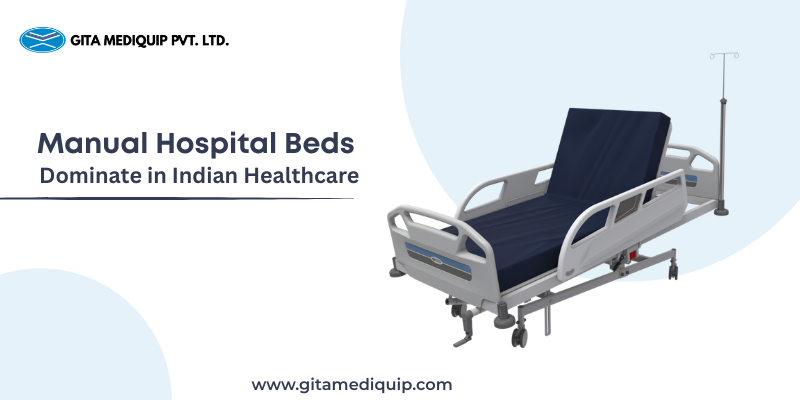
The medical advancements are increasing rapidly, and most healthcare facilities are expected to be automated. While automated or electric hospital beds are an integral part of health care settings, manual hospital beds continue to dominate Indian healthcare. For the premium intensive care units (ICU), electric beds are the standard; general wards and rural facilities still heavily rely on manual beds. The modern alternatives come with several features and advancements, but the manual hospital bed manufacturer designs beds that are economical, practical, and easily accessible, being a preferred choice for many hospitals.
Here are the key reasons why manual hospital beds remain dominant in India:
Affordability
The India hospital beds market is segmented by bed type into manual beds, semi-electric beds, and fully electric beds, where manual beds have the highest market share largely due to their affordability. The manual beds are practical, suitable, and cost-effective for rural and tier-2 healthcare centers. Their simplicity and low maintenance cost make them the first choice for budget-conscious facilities and government tenders.
Zero Power Dependency
The semi-electric and fully electric beds have impeccable features, but they require electricity, which is uncertain in rural areas. This is where manual beds rule with simple mechanical parts and hand cranks, and remain operational regardless of power availability.
Staff Familiarity and Training
Healthcare workers across India are widely accustomed to operating manual hospital beds. It requires proper training for healthcare staff to transition from manual to electric beds, which adds financial cost and time, which cannot be possible for hospitals with restricted resources and understaffing; hence, they stick to familiar equipment.
Ease of Maintenance
Manual beds are mechanically simple. While electric beds rely on wiring, motors, and a power supply, they require trained technicians to repair them. On the contrary, manual beds can be fixed with basic tools in minimal time.
Conclusion
While the healthcare settings are shifting towards electric bed adoption in premium hospitals and ICUs, manual beds will still continue to dominate the overall Indian market. The manual hospital beds are perfectly suitable for general wards, maternity, and noncritical care. They represent a solution that aligns closely with the country’s diverse healthcare needs and infrastructure realities.